
King Kamehameha Day - June 11, 2026
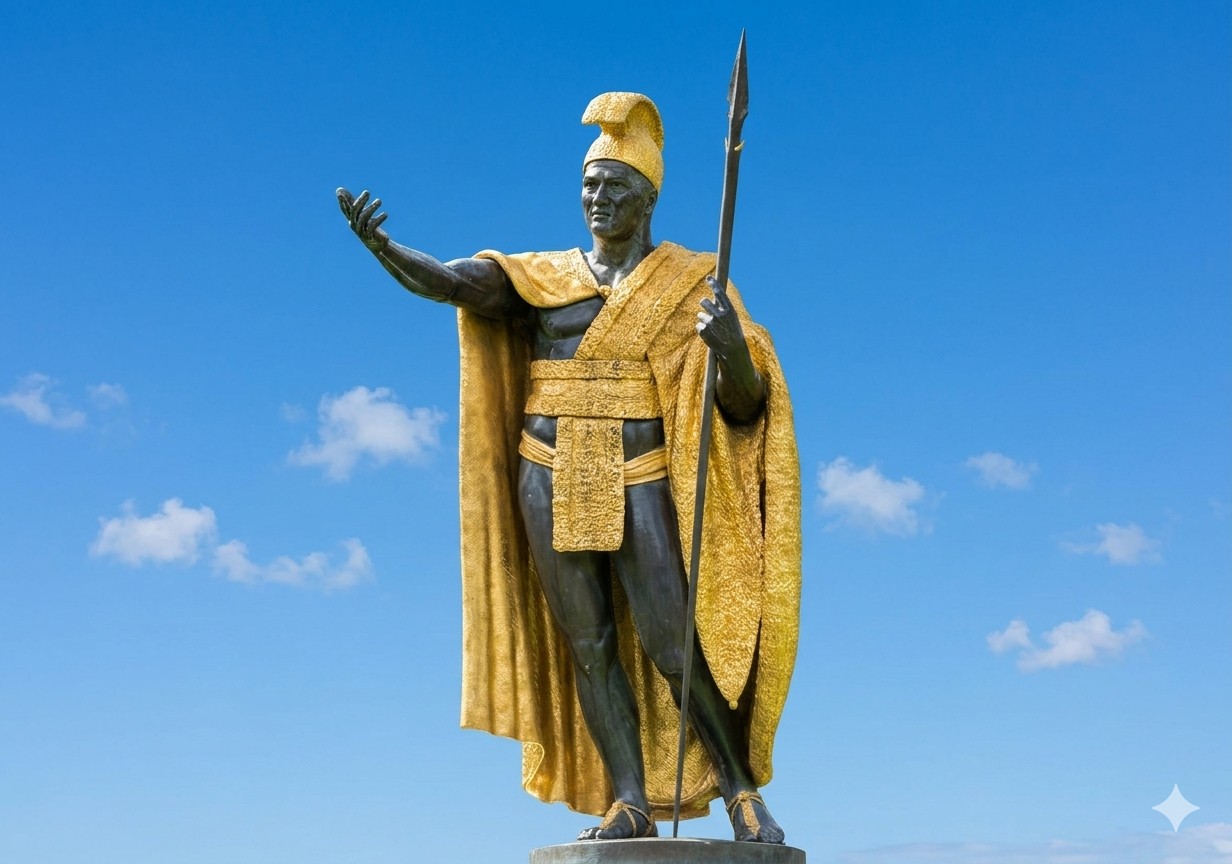
King Kamehameha Day falls on June 11 in recognition of the ruler who turned a scattered chain of rival islands into a single, sovereign Hawaiian kingdom. What made him remarkable was not just military dominance but the speed with which he moved from contested chief to undisputed king of every major island in the archipelago. The occasion draws thousands into the streets each year, with parades, hula performances, and floral arrangements that transform entire city blocks into living monuments. Nowhere is this more striking than in downtown Honolulu, where elaborate leis stretching thirty feet are draped across a towering bronze statue until the king himself seems buried in flowers.
King Kamehameha Day History
Kamehameha the Great was a Hawaiian monarch whose military genius and political vision transformed a fractured group of rival chiefdoms into a unified kingdom. His birth in Kohala around 1758 coincided with the passage of Halley's Comet across Hawaiian skies, an omen so charged with prophetic significance that rival chiefs viewed the infant as a threat and forced his family to conceal him for years. King Kamehameha Day was eventually established to preserve this legacy and give each generation a structured reason to revisit the story of the islands' founding ruler. When he finally emerged from hiding, Kamehameha began his education under King Kalaniʻopuʻu, his uncle and the reigning chief, who recognized in his nephew an extraordinary capacity for warfare and leadership.
One episode from his youth became the stuff of legend: Kamehameha reportedly lifted the Naha Stone, a 2.5-ton slab long said to be unmovable by any man not destined to unite the islands. The same uncle who supervised his training also arranged an introduction to English explorer James Cook aboard the HMS Discovery, a meeting that foreshadowed the foreign entanglements that would define Kamehameha's later reign. Cook was killed in a confrontation with Hawaiians in 1779, a moment that underscored how volatile contact between the islands and the outside world had become. When Kalaniʻopuʻu died in 1782, he bequeathed the war god Kuka'ilimoku to Kamehameha, while his own son Kīwalaʻō received political authority over the island, a division that made armed conflict all but inevitable.
The battle between Kamehameha and Kīwalaʻō was swift and decisive, ending with Kamehameha in control of the island and Kīwalaʻō's daughter Keōpūolani taken as his wife. He subsequently cultivated alliances with foreign advisors Isaac Davis and John Young, who helped him acquire Western cannons and firearms in exchange for Hawaii's prized sandalwood. Armed with this firepower, Kamehameha launched a campaign against Maui in 1790 and steadily absorbed the remaining islands through a combination of military pressure and diplomatic maneuvering. By 1810, every major island had come under his authority, making him the first ruler of a unified Hawaiian kingdom. He governed according to the ancient kapu system while also introducing laws like Kānāwai Māmalahoe, which guaranteed safe passage to travelers and the defenseless, a principle progressive enough that a refined version was written into Hawaii's state constitution in 1978.
Why King Kamehameha Day Matters
Ancient Principles, Modern Law
Kamehameha's legal code protected the vulnerable at a time when most rulers measured power solely by conquest. That instinct toward structured protection found its way into modern Hawaiian law, connecting an ancient kingdom's principles to a contemporary state constitution. Few leaders from the early 19th century left behind legal ideas durable enough to survive into a 20th-century constitution.
Fragmented Past, Unified Present
Before a single ruler brought them together, the Hawaiian Islands were a patchwork of competing chiefdoms kept apart by war and geography. Understanding that history gives the landscape itself a different weight, every valley and shoreline a potential battlefield that eventually became part of something unified. Hawaii officially became the 50th U.S. state in 1959, but the kingdom Kamehameha built is the deeper foundation beneath that modern identity.
Spectacle Worth Witnessing
Few public observances match the visual impact of leis stretching thirty feet across a towering bronze statue. The sheer scale of the floral tributes transforms familiar downtown spaces into something genuinely extraordinary for both residents and visitors. Parades wind through island towns while hula dancers perform in open plazas, making the event as much a sensory experience as a civic one.
How to Celebrate King Kamehameha Day
Weave Flowers Into Garlands
Making a lei by hand requires only fresh blooms, a needle, and some patience, and the process itself is meditative in a way that store-bought versions never quite replicate. Even a modest string of garden flowers captures something of the spirit that fills Honolulu's streets on June 11. Traditional Hawaiian lei-making is a craft passed down through families, and trying it connects the maker to something much older than the occasion itself.
Map a Monument Pilgrimage
Kamehameha's likeness stands in four locations across the Hawaiian Islands, with additional monuments placed in Washington, D.C. and Las Vegas, Nevada. Plotting a long-term itinerary around all of them turns an ordinary travel bucket list into something with real historical purpose. The contrast between the island statues and the one standing inside the U.S. Capitol building is striking in its own right.
Decode the Ceremonial Title
The king's complete ceremonial name runs to roughly forty syllables and constitutes a genuine tongue workout: "Kalani Paiʻea Wohi o Kaleikini Kealiʻikui Kamehameha o ʻIolani i Kaiwikapu kauʻi Ka Liholiho Kūnuiākea." Mastering even a rough approximation earns serious respect. Each segment of the name carries meaning tied to lineage, place, and prophetic expectation.
Facts About King Kamehameha
Stone Still on Display
The massive slab Kamehameha allegedly lifted now sits outside the Hilo Public Library on the Big Island, where visitors can see it in person.
Dozens of Children
Historical accounts place the number of Kamehameha's children at approximately 35, born to a roster of wives that various records count between 21 and 30.
Sandalwood Changed Everything
Hawaii's fragrant sandalwood was so valuable to foreign traders that Kamehameha used it as his primary bargaining chip for acquiring European and American weapons technology.
Burial Location Never Found
In keeping with Hawaiian tradition, Kamehameha's bones were hidden after his death in 1819 to prevent desecration, and their location has never been confirmed.
Dynasty Ran Three Generations
After Kamehameha's death, Liholiho ruled as Kamehameha II, followed by his brother Kauikeaouli, who took power as Kamehameha III and oversaw Hawaii's transition into a constitutional monarchy.
King Kamehameha Day Dates
| Year | Date |
| 2026 | June 11 |
| 2027 | June 11 |
| 2028 | June 11 |