
Yarn Bombing Day - June 11, 2026
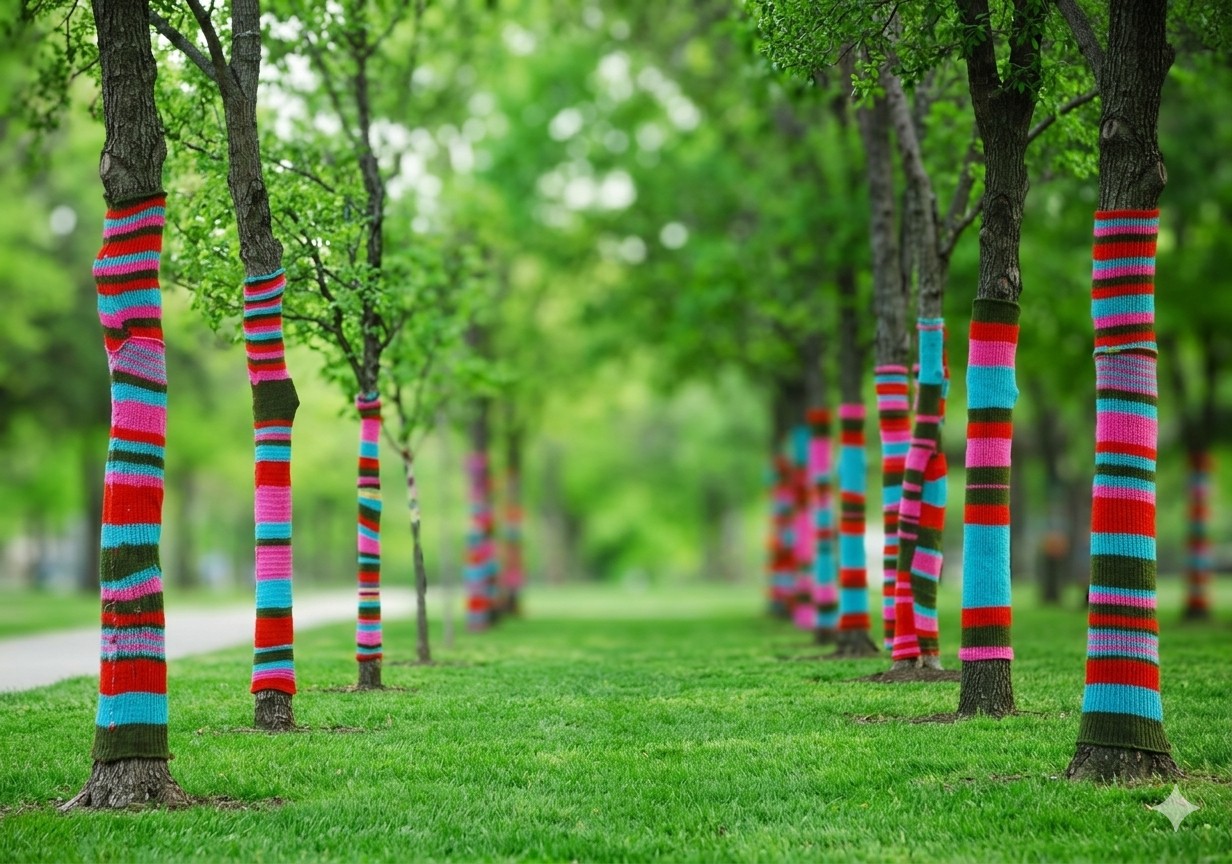
Yarn Bombing Day is marked every June 11, when crafters worldwide take their needles and wool out of the living room and into the street. There is something quietly radical about waking up to find a park bench wrapped in wool or a lamppost wearing a crocheted sleeve, as if the street itself had decided to get cozy. The people behind these installations use fiber the way others use spray cans, except the result tends to make strangers smile rather than call the authorities. Somewhere between a craft circle and an act of gentle rebellion, yarn bombing has grown from a single boutique door handle in Houston into a worldwide phenomenon.
Yarn Bombing Day History
Yarn bombing as a practice sits at a fascinating crossroads between fiber craft and urban intervention, using wool, hooks, and needles as tools for reshaping shared environments rather than private ones. The movement found its spark in Houston in 2005, when Magda Sayeg wrapped the door handle of her boutique in a custom knitted cozy, a gesture so unexpectedly charming that passersby stopped to stare. From that single handle, Sayeg's impulse spread through her neighborhood, then outward across cities, continents, and cultural scenes that had never previously connected handcraft with public space. Before Sayeg, Houston already had a quiet predecessor in Bill Davenport, who had been exhibiting crochet-covered objects as sculpture throughout the 1990s, and in 2002 artist Shanon Schollian brought the impulse to Oregon, wrapping stumps left by clear-cutting.
London gave the movement its narrative depth through the work of Lauren O'Farrell, who founded Knit the City, the city's first collective dedicated to graffiti knitting. O'Farrell introduced the concept of the stitched story, an approach that wove together hand-sewn amigurumi figures and characters to tell a coherent visual tale across urban surfaces. The collective also coined a softer term for the practice, preferring "yarn storming" over the more aggressive-sounding original, a shift that reflected their belief in craft as invitation rather than intrusion. Their installations gave the movement an intellectual framework it had previously lacked, transforming scattered individual acts into something with shared language and purpose.
Yarn Bombing Day came into existence through a single act of civic enthusiasm: in June 2011, Joann Matvichuk of Lethbridge, Alberta, designated June 11 as the occasion, giving crafters worldwide a fixed point around which to organize their energy. That same September, the Collected Thread shop in Oklahoma City marked its third anniversary by yarn bombing the entire Plaza District, a vivid demonstration of how the observance had already leapt from individual makers to businesses and neighborhoods. Since then the tradition has taken root across dozens of countries, with installations ranging from tiny lamppost cozies to enormous knitted murals draped across bridges and facades.
Why Yarn Bombing Day Matters
Craft Carries Personal History
Every knitter carries a lineage of people who put needles in their hands and showed them the first stitch, and that chain of transmission gives the craft a deeply personal emotional weight. The smell of a particular wool or the sight of a familiar pattern can surface memories of kitchens, grandparents, and quiet afternoons that exist nowhere else. Handcraft keeps those connections alive in a way that photographs and stories alone cannot.
Rhythm Quiets the Mind
The steady, repetitive motion of working yarn through loops has a measurable calming effect on the nervous system, lowering heart rate and easing mental tension in ways similar to meditation. Crafters often describe entering a focused but relaxed mental state during long sessions, sometimes called the "knitting zone." Few creative outlets offer the same combination of productive output and genuine mental rest.
Wool Builds Real Bonds
Fiber arts have always thrived in group settings, from neighborhood circles to prison workshops where craft becomes a shared language across difference. Picking up needles alongside others creates an easy, low-pressure environment where conversation flows and connections form without effort. The social dimension of knitting is inseparable from the pleasure of it.
How to Celebrate Yarn Bombing Day
Gather Friends for a Collaborative Piece
Organize a small group around a shared project and divide the knitting among participants, each contributing squares, strips, or figures that eventually come together as a single installation. Working collectively speeds up production dramatically and turns the event into a social occasion worth repeating. Planning where to display the finished piece adds an extra layer of excitement to the whole afternoon.
Explore Iconic Installations Online
Searching for landmark yarn bombing projects from around the world reveals an astonishing range of scale and imagination, from a knitted shark emerging from a rooftop in Oxford to entire fighter jets wrapped in crochet. Browsing these works online connects you to the broader creative community and often sparks ideas that would never have arrived otherwise. Many artists document their process in detail, making it easy to follow along and learn new techniques.
Wrap Something Unexpected
Choose an object at home or in your garden and give it a knitted or crocheted sleeve: a fence post, a bicycle wheel, a lampshade, or a flowerpot all make surprisingly satisfying canvases. The piece does not need to be elaborate; even a single strip of colorful ribbing transforms an ordinary object into something worth a second look. Starting small makes the process feel approachable rather than daunting.
Facts About Yarn Bombing
Unexpected Pioneer
Bill Davenport was exhibiting crocheted sculptures in Houston galleries throughout the 1990s, years before the street movement had a name.
Diplomatic Installations
Yarn bombing has been used in international diplomacy contexts, with knitted flags and symbols appearing at border crossings as gestures of goodwill between communities.
Record-Breaking Coverage
The largest documented yarn bombing project covered an entire passenger train in Switzerland, wrapping carriages, seats, and luggage racks in coordinated textile patterns.
Museum Recognition
Several major art museums, including institutions in the United States and Europe, have acquired yarn bombing works for their permanent contemporary art collections.
Material Lifespan
Outdoor yarn installations typically last between two weeks and three months before weather degrades the fiber, making each piece an inherently temporary and site-specific artwork.
Yarn Bombing Day Dates
| Year | Date |
| 2026 | June 11 |
| 2027 | June 11 |
| 2028 | June 11 |