
National Flag Day - June 14, 2026
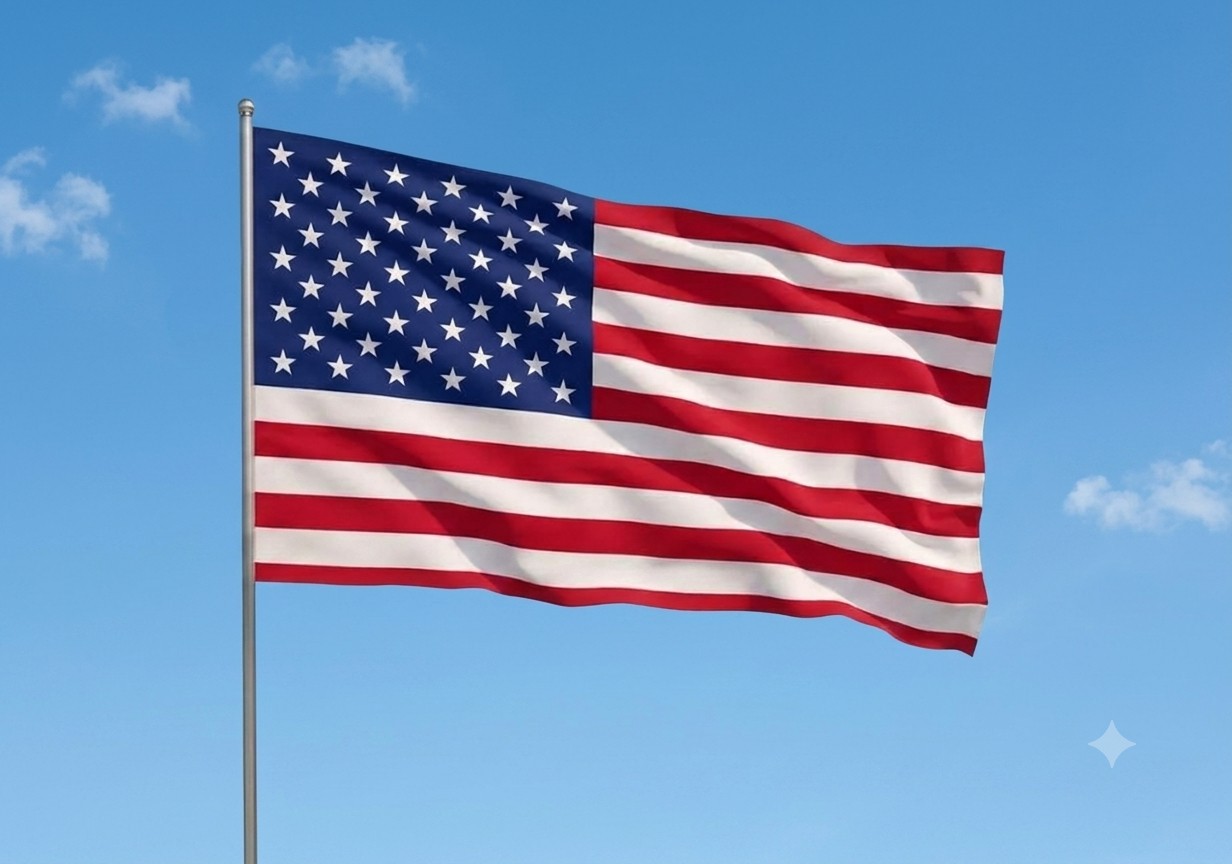
National Flag Day is observed each year on June 14 to recognize the banner that has represented American identity, unity, and change. Few objects carry as much symbolic weight in American life as the Stars and Stripes, a design that has quietly evolved alongside the nation itself. Each stripe still recalls the original thirteen colonies, while every star marks a state that joined the union, turning a piece of cloth into a living record of national growth. From schoolyards to federal buildings, June 14 brings a moment to look up and consider what that familiar pattern of red, white, and blue actually represents.
National Flag Day History
Flags as national symbols carry a long prehistory, but the American version was born from a very specific political need: a young republic at war had to distinguish itself from the British Crown, and a new emblem was the clearest way to do it. The Flag Resolution passed by the Second Continental Congress on June 14, 1777, established thirteen stars and thirteen stripes as the official design, though it said nothing about how those elements should be arranged, leaving individual flag-makers to improvise. President Woodrow Wilson gave the anniversary formal standing in 1916 when he proclaimed National Flag Day, dedicating an annual observance to the emblem that had already guided the nation through wars, westward expansion, and decades of change.
As new states entered the union, the flag's star count climbed, but the stripe count also grew at first, reaching fifteen by 1794 to reflect the additions of Vermont and Kentucky. That approach quickly became impractical, and the Flag Act of 1818 locked the stripe count permanently at thirteen while allowing stars to increase with each new state. The process has a precise rhythm to it: a new star does not appear immediately upon statehood but is added on the following July 4, a detail that gives each updated flag its own specific anniversary.
The version flown today has been unchanged longer than any other design in American history. Hawaii became the fiftieth state in August 1959, and the fifty-star flag was raised for the first time on July 4, 1960, where it has remained ever since. Proposals to add a fifty-first star resurface periodically, tied to ongoing statehood discussions involving Puerto Rico and Washington, D.C., meaning the flag's long stable period may not be permanent.
Why National Flag Day Matters
A Living Civic Lesson
The flag's design is not arbitrary decoration but a compressed history lesson: thirteen stripes, fifty stars, and a sequence of additions that maps directly onto the country's territorial growth. Spending time with that visual record invites questions about statehood, representation, and who gets counted as part of the American story. June 14 turns a familiar image into a genuine starting point for that kind of inquiry.
Neighborhood Roots Run Deep
Unlike major federal holidays, this observance has always had a distinctly local character, built around community parades, school ceremonies, and municipal events rather than national broadcasts or government mandates. Towns and counties that observe it tend to do so with consistent local traditions that have been repeated for generations. That grassroots texture makes it feel personal in a way that larger celebrations sometimes lose.
Shared Symbol, Divided Nation
At a time when Americans disagree on a great deal, the flag remains something nearly everyone claims as their own, giving this occasion a rare quality of belonging to no single group or viewpoint. Patriotism expressed through the flag is broad enough to hold very different ideas about what the country is and what it should become.
How to Observe National Flag Day
Create Your Own Version
Making a flag-inspired piece of art, whether through watercolor, mosaic, paper cutting, or garden planting, shifts the relationship from passive observer to active participant. Community art projects organized around the red, white, and blue often produce surprisingly inventive results, with contributions ranging from quilted panels to flower arrangements. The act of constructing the design forces a closer look at its geometry and proportions than simply watching a flag wave ever could.
Host a Trivia Round
The flag's history is full of details that surprise even people who consider themselves well-informed, from the fact that Betsy Ross is one of several figures credited with sewing the first flag, to the rule that new stars only appear on July 4. Organizing a short trivia game at a backyard gathering or school event turns those facts into something genuinely engaging. A small prize keeps the energy up and gives everyone a reason to actually remember what they learned.
Fly It Properly
Displaying the flag correctly, with the union field in the upper left, raised briskly and lowered ceremonially, is itself a meaningful act that many Americans have never been formally taught. Taking a few minutes to review flag etiquette and then putting it into practice outside your home or workplace gives the day real substance. Neighbors and passersby often notice, and the gesture tends to prompt conversations.
Facts About the American Flag
Oldest Unchanged Design
The fifty-star flag has been in continuous use since 1960, making it the longest-serving version of the Stars and Stripes in the nation's entire history.
Specific Shade Requirements
The exact colors of the flag are defined by precise Pantone standards: Old Glory Red, Old Glory Blue, and white, ensuring consistency across every official reproduction.
Retiring by Fire
The U.S. Flag Code specifies that worn or damaged flags should be retired through burning in a dignified ceremony, a practice carried out annually by veterans' organizations across the country.
Astronauts Planted Six
Six American flags were planted on the lunar surface during the Apollo missions between 1969 and 1972, though solar radiation has likely bleached most of them white by now.
No Trademark Protection
The American flag design itself cannot be trademarked or copyrighted, which is why it appears freely on commercial products, though the Flag Code discourages using it for decorative or advertising purposes.
National Flag Day Dates
| Year | Date |
| 2026 | June 14 |
| 2027 | June 14 |
| 2028 | June 14 |